
[ad_1]
Key Takeaways
The Nationwide Sheriffs’ Affiliation despatched Thune and Schumer a contemporary CLARITY Act warning.Blockchain Affiliation’s Lindsay Fraser believes the NSA’s place comes from a spot of “basic misunderstanding.”The dispute facilities on Part 604, which shields non-custodial software program builders.
A Renewed Warning From Legislation Enforcement
The Nationwide Sheriffs’ Affiliation despatched a letter to Senate Majority Chief John Thune and Democratic Chief Chuck Schumer warning that the CLARITY Act, as at the moment written, would create broad exemptions from registration, know-your-customer, anti-money-laundering, and sanctions-law necessities for sure decentralized-finance contributors, probably permitting illicit actors to take advantage of platforms and providers designed to obscure digital-asset transactions.
It isn’t the affiliation’s first warning on the topic, because the NSA first raised the identical objection in a Could 13 letter to the Senate Banking Committee, then joined a four-organization coalition letter in late June that repeated the warning nearly verbatim, which means the August letter is much less a brand new alarm than a 3rd reiteration of the identical core criticism because the Senate’s recess deadline closes in.
The sheriffs’ group just isn’t performing alone, becoming a member of the Nationwide District Attorneys Affiliation, the Nationwide Affiliation of Assistant United States Attorneys, and the Worldwide Affiliation of Chiefs of Police in warning that the invoice’s remedy of DeFi may open gaps traffickers, sanctions evaders, and cash launderers would exploit, a coalition whose joint letter dates to late June and whose core argument has been echoed in every NSA letter since.
The particular goal of the coalition’s objection is Part 604 of the invoice, a provision generally known as the Blockchain Regulatory Certainty Act, which carves out protections for builders who construct non-custodial software program, wallets, and protocols with out ever taking management of consumer funds.
Legislation enforcement teams argue that carve-out is written broadly sufficient to let genuinely custodial or laundering-facilitating operations declare the identical defend, weakening Know-Your-Buyer and Anti-Cash-Laundering requirements relative to what conventional monetary establishments should observe.
The Business’s Rebuttal
The Blockchain Affiliation has not let the argument go unanswered, sending out a message of clear pushback.
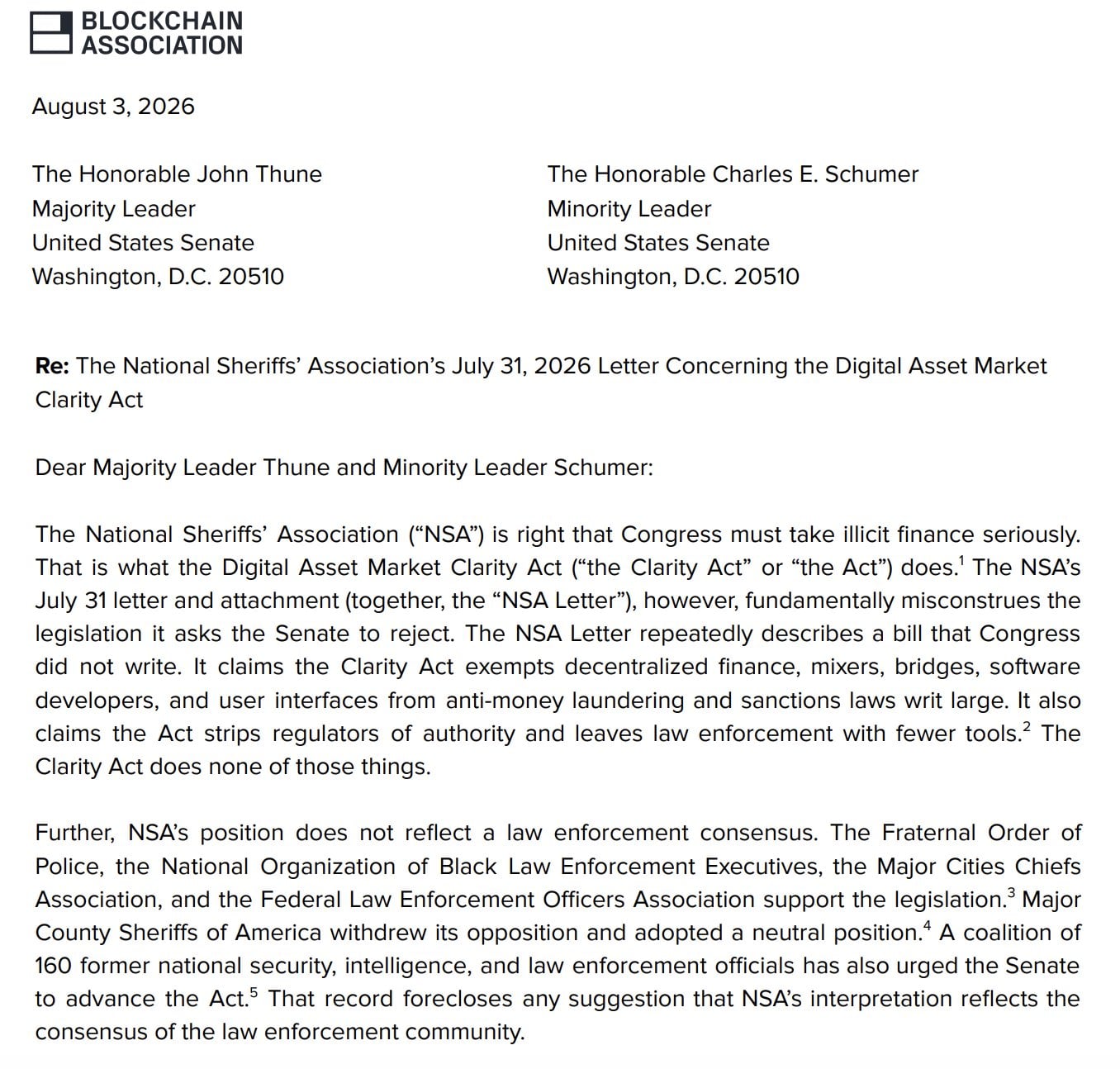
Furthermore, when the four-organization coalition first raised the identical criticism in June, Lindsay Fraser, the commerce group’s chief coverage officer, dismissed the studying of Part 604 as a “basic misunderstanding” of what the supply truly does, saying:
Part 604 does one slim factor: it prevents non-custodial software program builders from being misclassified as cash transmitters when they don’t custody belongings or management transactions.
She went additional in rejecting the concept that the supply creates a loophole for unhealthy actors, stating plainly that it “doesn’t immunize criminals,” “doesn’t restrict sanctions enforcement,” and “doesn’t cease prosecutions for cash laundering, fraud, or terrorist financing.”
A Break up That Might Resolve the Vote
The standoff illustrates why the CLARITY Act’s legislation enforcement query has turn out to be its personal subplot contained in the broader Senate battle. Not like the ethics dispute over Trump’s crypto enterprise ties or the stablecoin oversight questions which have individually slowed negotiations, the Part 604 battle pits working legislation enforcement organizations instantly towards the trade group lobbying hardest for passage, with either side claiming to symbolize public security.
The legislation enforcement group itself is way from unified on the supply. The Nationwide Group of Black Legislation Enforcement Executives formally endorsed the invoice on July 1, turning into the primary main legislation enforcement group to again it outright, arguing it preserves longstanding prison enforcement authorities whereas including significant new capabilities.
Two days later, on July 3, Main County Sheriffs of America, a separate group from the Nationwide Sheriffs’ Affiliation representing sheriffs’ workplaces serving 130 million individuals, shifted from energetic opposition to impartial on Part 604 particularly, telling the Senate Banking Committee that continued talks had supplied further readability on how the supply would truly be carried out.
With Thune saying the Senate nonetheless expects to carry a flooring vote earlier than the August recess and roughly 4 legislative days left on the clock, this battle over developer legal responsibility has turn out to be one of many extra granular and extra consequential.
[ad_2]
Source link
Frequently Asked Questions
What is the main concern of the Nationwide Sheriffs’ Affiliation regarding the CLARITY Act?
The Nationwide Sheriffs’ Affiliation warns that the CLARITY Act, as currently written, could create broad exemptions from registration and anti-money-laundering requirements for decentralized finance contributors, potentially allowing illicit actors to exploit platforms designed to obscure digital-asset transactions.
What does Part 604 of the CLARITY Act address?
Part 604, known as the Blockchain Regulatory Certainty Act, provides protections for non-custodial software developers, preventing them from being misclassified as money transmitters when they do not control user funds or transactions.
How does the Blockchain Association respond to the concerns about Part 604?
The Blockchain Association, represented by Lindsay Fraser, argues that the concerns about Part 604 stem from a fundamental misunderstanding. They assert that the provision does not immunize criminals or limit sanctions enforcement, and it does not prevent prosecutions for money laundering or fraud.
Which law enforcement groups have expressed concerns about the CLARITY Act?
The concerns about the CLARITY Act have been raised by the Nationwide Sheriffs’ Association, the Nationwide District Attorneys Affiliation, the Nationwide Affiliation of Assistant United States Attorneys, and the Worldwide Affiliation of Chiefs of Police, all warning about potential exploitation by illicit actors.
What was the stance of the Nationwide Group of Black Legislation Enforcement Executives on the CLARITY Act?
The Nationwide Group of Black Legislation Enforcement Executives officially endorsed the CLARITY Act on July 1, arguing that it preserves existing law enforcement authorities while adding meaningful new capabilities.


